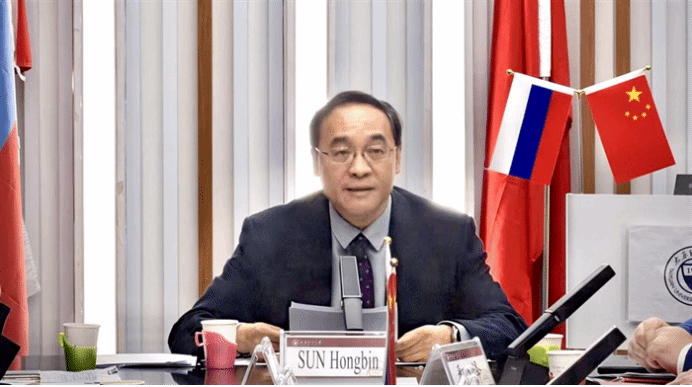
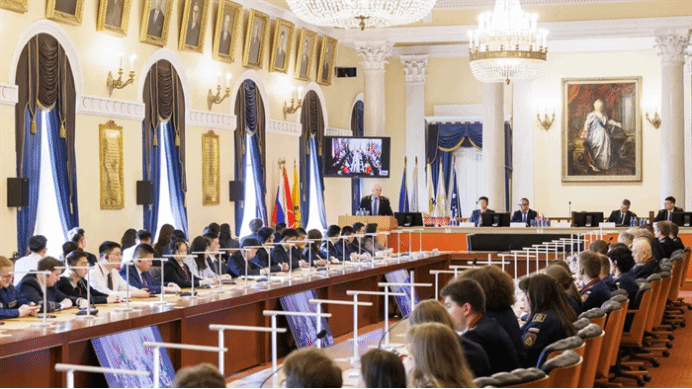
At 15:00 Beijing time (10:00 Moscow time) on March 24, the “Towards Science” International Scientific and Practical Dialogue, co-organized by TYUT and Saint Petersburg Mining University, commenced. The conference was held in a hybrid format, with the main venue at SPMU and an online sub-venue at TYUT’s Yingxi Campus. Attendees included SPMU Rector Vladimir Litvinenko, Luo Zhanhui, Consul General of the People’s Republic of China in St. Petersburg, Sun Hongbin, TYUT President and Academician of the Chinese Academy of Sciences, and Yang Xiaowei, TYUT Academic Vice President, along with representatives from relevant administrative and academic departments, as well as faculty and students from both sides.
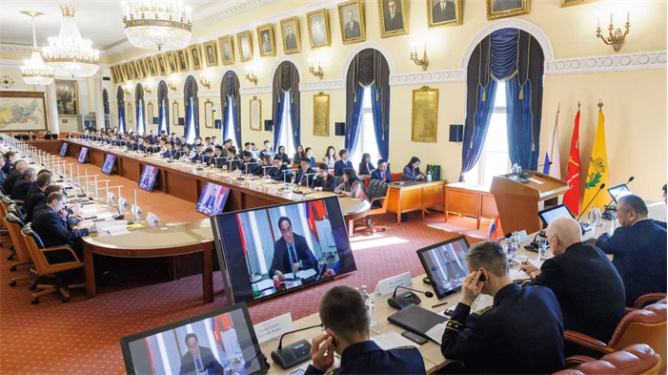
In his opening address, Sun Hongbin stated that TYUT consistently regards internationalization as a key pathway to enhancing the quality of postgraduate education, possessing a strong research foundation in areas such as clean energy technologies in extreme environments and Antarctic scientific expeditions. He noted that SPMU, as the cradle of engineering education in Russia, has a profound educational heritage, and the core disciplines of TYUT and SPMU are highly aligned, building on a strong foundation for cooperation. He expressed his hope that, building on existing cooperation in joint doctoral programs, both joint and overseas education, and educational resource sharing, the two sides would deepen scientific research collaboration in areas such as Antarctic and polar expeditions and jointly cultivate high-caliber talents with a global perspective and innovative capabilities.
Litvinenko delivered a welcome speech, in which he reviewed the profound history of educational cooperation between the two countries. He noted that 2026 marks the 250th anniversary of the birth of Russia’s first domestic mining engineer, and emphasized that the core of this forum is to engage in dialogue on the quality of knowledge among Chinese and Russian graduate students and the cultivation of engineering talents in the digital era. He expressed his hope to take this forum as an opportunity to deepen practical cooperation between TYUT and SPMU in areas such as joint postgraduate education and collaborative scientific research innovation.
Luo Zhanhui remarked in his address that the period of 2026-2027 marks the China-Russia Years of Education. He noted that this forum aligns with the goals of integrated development in education, science and technology, and talent outlined in China’s 15th Five-Year Plan. He expressed his hope that TYUT and SPMU would leverage research to promote learning and collaboration, continuously deepening educational exchanges and scientific research cooperation between Chinese and Russian universities, thereby injecting new momentum into the people-to-people and cultural exchanges and scientific and technological cooperation between China and Russia.
Under the theme of Integrating Methodologies for Cultivating Talent in Science and Education, and Improving Higher Engineering Education, the dialogue featured a plenary session and three parallel sessions. The plenary session focused on core issues such as the reform of postgraduate education models, disciplinary development, and scientific research cooperation, facilitating the sharing of practical experiences in engineering education system reform and the collaboration between industries, universities, and research institutes. The parallel sessions concentrated on three main areas: mineral prospecting, exploration and mining; sustainable development in the resource-based industry; and general industrial technologies. Participating graduate students presented their research findings in the form of themed presentations, demonstrating a complete methodology ranging from topic selection to information processing. Faculty and students from TYUT and SPMU engaged in in-depth discussions on cutting-edge issues in their respective fields.
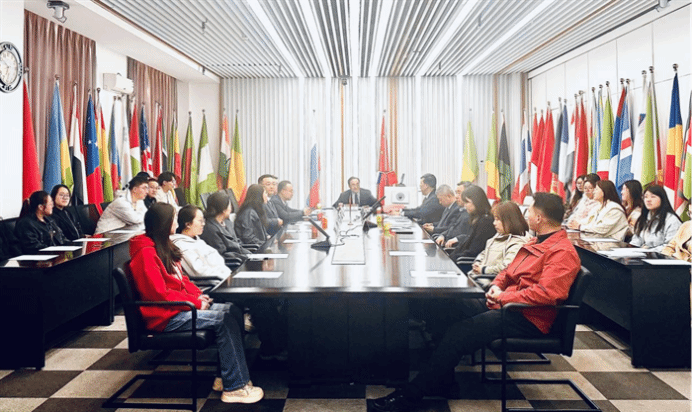
This dialogue serves as a significant opening for academic exchange activities between TYUT and SPMU. Both sides will take this opportunity to further deepen practical cooperation, continuously broaden inter-university exchange channels, and expand bilateral cooperation into deeper levels and broader fields.


 Go Back