On May 14, Clarivate Analytics released the latest “Essential Science Indicators” (ESI) data, revealing that Taiyuan University of Technology’s Chemistry has officially entered the global top 1‰, driven by its outstanding academic influence and research output. This marks TYUT’s third discipline to join the world’s top tier, following Engineering and Materials Science, and represents another landmark achievement in TYUT’s journey to establish itself as a world-class, open, and research-oriented university with distinct characteristics.
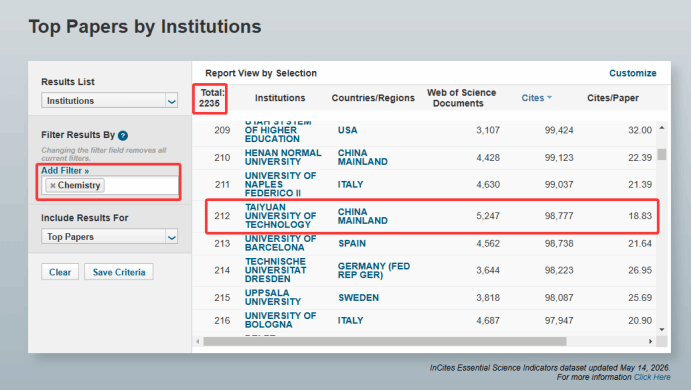
Within the international academic benchmarking system, TYUT’s Chemistry has demonstrated strong competitive positioning and momentum for development. During the current statistical period (January 2016 to February 2026), a total of 2,235 institutions worldwide ranked within the top 1% in chemistry. TYUT ranked 212th globally, achieving a ranking of 0.95‰—a successful transition from the top 1% to the top 1‰. Over the statistical period, the discipline published a total of 5,247 papers, which have been cited 98,777 times, averaging 18.83 citations per paper, and includes 47 ESI Highly Cited Papers. This impressive set of data not only reflects the dedication and hard work of TYUT’s research teams in the laboratory but also serves as a direct indicator of TYUT’s continuously improving research quality and academic reputation.
The significant leap in the discipline’s standing is deeply rooted in TYUT’s recent strategic focus on comprehensive reform and substantive development. In recent years, TYUT has closely aligned itself with national strategies and the needs of high-quality regional development, boldly reforming its research evaluation system and resolutely moving away from a “publication-only” approach. Through institutional innovation, TYUT has greatly unleashed the original innovative potential of academic teams. Adhering to the educational philosophy of “student-centered and faculty-focused,” TYUT has deeply implemented Five Major Development Strategies, including talent revitalization and reform innovation, while steadily advancing Ten Key Projects and Ten Reform Initiatives. Meanwhile, TYUT has actively broken down barriers between colleges and disciplines. Through talent recruitment and cultivation, it has fostered deep cross-disciplinary collaboration between chemistry and its strengths in materials and engineering. This has led to the emergence of a “matrix of top-tier disciplines,” continuously releasing the dividends of reform.
Standing at this new threshold of the global top 1‰, TYUT will plan its future with a broader international perspective. This achievement of chemistry entering the world’s most elite “top thousand” group has instilled great confidence in faculty and students alike. Moving forward, TYUT will remain unwavering in its commitment to reform and innovation, using high-level disciplinary development as an engine to continuously elevate its overall research capacity and the quality of its high-level talent cultivation. On its journey toward “Double First-Class” construction, TYUT is advancing with confidence and accelerating its pace toward becoming a distinctive, high-level world-class university.
It is worth noting that ESI is a core indicator tool widely used worldwide to evaluate the international academic standing of universities and research institutions. Chinese universities participating in the “Double First-Class” initiative generally regard the number of disciplines ranked in the ESI global top 1% and top 1‰ as key benchmarks. The breakthrough in chemistry signifies that TYUT now possesses significant core competitiveness and global influence on the international academic stage.


 Go Back