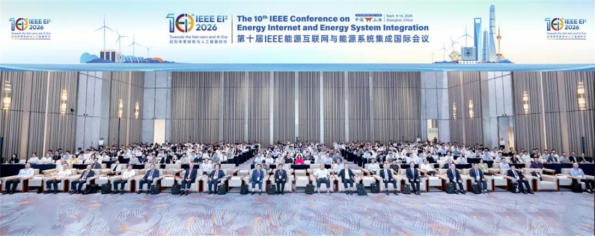
From September 12 to 14, the 10th IEEE Conference on Energy Internet and Energy System Integration (IEEE EI² 2026), co-organized by Taiyuan University of Technology (TYUT), Shanghai University of Electric Power, and other institutions, was held in Shanghai’s Lin-gang Special Area. Sun Hongbin, an Academician of the Chinese Academy of Sciences and President of TYUT, delivered a keynote address and participated in a series of academic activities. Among the distinguished guests attending the conference were Song Lai, Secretary of the CPC Committee of Shanghai University of Electric Power; Tang Hao, Full-Time Deputy Director of the Administrative Committee of the Lin-gang Special Area of China (Shanghai) Pilot Free Trade Zone; Shu Yinbiao, an Academician of the Chinese Academy of Engineering and President of the Chinese Society for Electrical Engineering; and C.Y. Chung, a Fellow of the Canadian Academy of Engineering and President of the IEEE Power & Energy Society (PES). The conference brought together 13 academicians and more than 1,000 experts and scholars.
Under the theme “Towards the Net-Zero and AI Era,” this year’s conference marked the 10th anniversary of its founding. Experts and scholars engaged in in-depth discussions on fundamental research, key technological breakthroughs, and engineering applications in the power and energy sector.
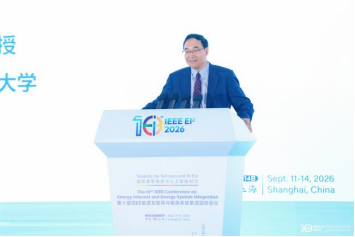
As Chair of the Conference Committee, Academician Sun Hongbin delivered a keynote address entitled “The Next-Generation Energy Internet: Concepts, Architecture, Case Studies, and Prospects.” He noted that the convergence of artificial intelligence and renewable energy presents significant opportunities for the global energy transition, and that the energy internet serves as a key vehicle for promoting multi-energy coordination and achieving China’s “dual carbon” goals. He said that TYUT, responding to national energy strategy priorities and drawing on its strengths in electrical engineering, has continued its research in areas such as the Energy Internet, integrated energy systems, and polar clean energy. Sun expressed the hope that the university would use the conference as a platform to foster closer collaboration among universities, research institutions, and industry partners in China and abroad. Such collaboration, he noted, would facilitate the exchange of academic ideas, promote the translation of research findings into practical applications, advance scientific and technological innovation in the power and energy sector, and support the development of China’s new-type energy system.
During the conference, Sun also exchanged views with other participants on cutting-edge topics, including artificial intelligence technologies for the energy internet, zero-carbon and low-carbon interconnection systems, and key enabling technologies for new-type power systems.


 Go Back